Choosing the right PCB material is one of the most important decisions in electronic product development. The material used to manufacture a Printed Circuit Board (PCB) directly affects electrical performance, mechanical strength, thermal management, reliability, manufacturing cost, and the overall lifespan of the product.
A PCB designed for a simple consumer electronic device may have very different material requirements compared with a high-speed communication system, industrial controller, automotive electronics, IoT device, or power electronics application.
In this guide, we explain the key factors to consider when selecting the right PCB material for your project.
Why PCB Material Selection Matters
A PCB is made from several layers of materials, including conductive copper layers, dielectric materials, solder mask, and substrate materials.
The substrate provides the mechanical foundation of the PCB and influences important characteristics such as:
- Electrical insulation
- Signal integrity
- Thermal performance
- Mechanical strength
- Moisture resistance
- Operating temperature
- Manufacturing capability
- Overall PCB cost
Selecting the wrong material can result in signal losses, excessive heating, mechanical failure, reliability problems, or difficulties during manufacturing.
What is PCB Substrate Material?
The PCB substrate is the insulating material that supports the copper circuitry.
The most common PCB substrate used in electronics is FR-4, a glass-fiber-reinforced epoxy laminate.
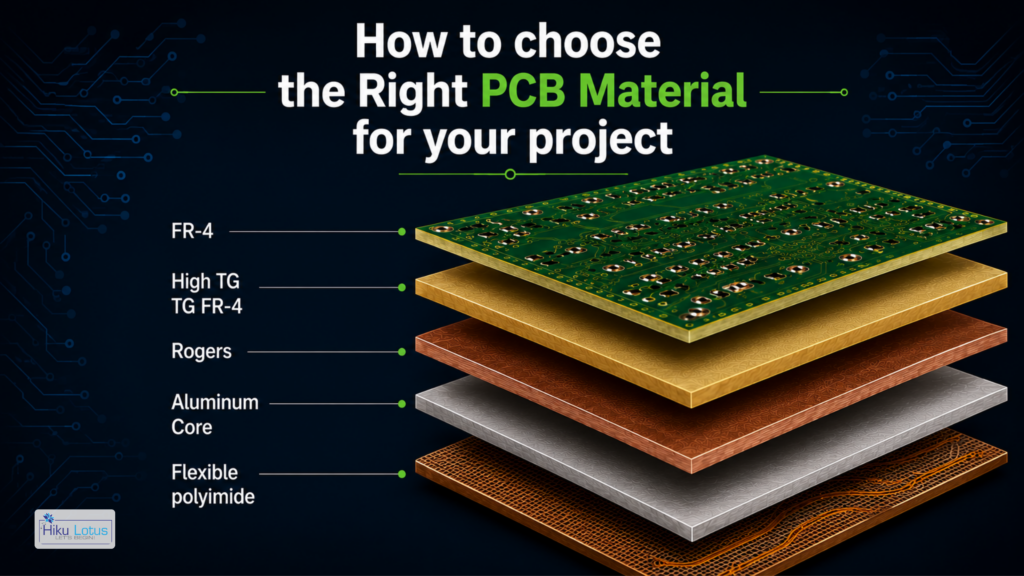
However, FR-4 is not the only option. Depending on the application, engineers may select materials such as:
- FR-4
- High-Tg FR-4
- Polyimide
- PTFE-based materials
- Metal-core PCB materials
- Flexible PCB materials
- High-frequency laminates
- Ceramic-based PCB materials
Each material offers different electrical, thermal, mechanical, and cost characteristics.
1. FR-4: The Most Common PCB Material
FR-4 is widely used because it provides a good balance between performance, reliability, manufacturability, and cost.
Typical applications include:
- Embedded systems
- Industrial controllers
- Consumer electronics
- IoT devices
- Control boards
- Communication equipment
- General-purpose electronics
For many standard electronic products, FR-4 is an excellent starting point.
However, not every FR-4 material is identical. Different grades can have different thermal and electrical properties.
2. Consider the Operating Temperature
Temperature is an important factor when selecting PCB material.
Electronic products may operate in environments with:
- High ambient temperatures
- Continuous heating
- Rapid temperature changes
- Industrial machinery
- Outdoor conditions
- Power electronics applications
For demanding thermal environments, high-Tg PCB materials may provide better performance than standard materials.
The glass transition temperature, commonly known as Tg, indicates the temperature at which the resin system changes significantly in mechanical behavior.
For high-temperature applications, engineers should carefully evaluate the material’s Tg and other thermal properties.
3. Evaluate Signal Frequency
The PCB material becomes increasingly important as signal frequency increases.
High-speed and RF applications require careful consideration of:
- Dielectric constant (Dk)
- Dissipation factor (Df)
- Controlled impedance
- Signal loss
- Material consistency
For high-frequency applications such as RF communication, wireless systems, radar, and high-speed digital electronics, specialized PCB laminates may be more appropriate than conventional FR-4.
Choosing the right material helps maintain signal integrity and minimize transmission losses.
4. Consider Thermal Performance
Power electronics and industrial control systems can generate significant heat.
Applications such as:
- Motor controllers
- Power supplies
- LED drivers
- Battery management systems
- Inverters
- Industrial power electronics
may require enhanced thermal management.
Depending on the design, engineers may consider:
- High-Tg materials
- Heavy copper PCBs
- Metal-core PCBs
- Thermal vias
- Larger copper areas
- Heat sinks
PCB material selection should therefore be considered together with the complete thermal design.
5. Mechanical Requirements
Mechanical strength is another important consideration.
The PCB may experience:
- Vibration
- Shock
- Bending
- Repeated thermal cycling
- Mechanical stress
- Connector insertion forces
Industrial and automotive applications may require materials capable of maintaining reliability under demanding mechanical conditions.
For applications requiring flexibility, flexible PCB materials such as polyimide may be more suitable than rigid FR-4.
6. Moisture and Environmental Conditions
Some electronic products operate in environments with high humidity, dust, chemicals, or temperature variations.
Examples include:
- Industrial automation equipment
- Outdoor IoT devices
- Agricultural equipment
- Marine electronics
- Process control systems
PCB material selection should consider moisture absorption and environmental reliability.
Additional protection may include:
- Conformal coating
- Encapsulation
- Sealed enclosures
- Appropriate surface finishes
- Environmental testing
The PCB material should be selected according to the complete operating environment.
7. Multilayer PCB Requirements
Modern electronic products frequently use multilayer PCBs.
A multilayer PCB may include:
- Signal layers
- Ground planes
- Power planes
- Internal routing layers
Material properties become particularly important when designing multilayer boards for high-speed applications.
The PCB stack-up should be planned carefully to achieve the required:
- Impedance
- Layer spacing
- Signal integrity
- Power integrity
- EMI performance
Working with the PCB manufacturer early in the design process can help ensure the selected material and stack-up are compatible with production requirements.
8. Flexible PCB Material
Flexible PCBs are designed to bend or conform to a specific mechanical structure.
They are commonly used in:
- Wearable electronics
- Compact devices
- Displays
- Cameras
- Medical electronics
- Automotive electronics
Polyimide is commonly used as a flexible PCB substrate because of its flexibility and thermal performance.
Flexible PCB material should be selected based on bending radius, operating temperature, mechanical stress, and expected flex cycles.
9. High-Frequency PCB Materials
Standard FR-4 can be suitable for many digital applications, but specialized materials may be required for high-frequency designs.
High-frequency applications include:
- RF communication
- Wireless systems
- Antenna circuits
- Radar
- High-speed networking
- Microwave electronics
Material selection should consider Dk, Df, impedance control, frequency range, and manufacturing tolerances.
For these applications, selecting the PCB material and stack-up together is particularly important.
10. Metal-Core PCB Materials
Metal-core PCBs are designed to provide improved thermal dissipation.
They typically use a metal base such as:
- Aluminum
- Copper
Metal-core PCBs are particularly useful for applications that generate substantial heat.
Common applications include:
- High-power LED lighting
- Power electronics
- Motor control
- Automotive lighting
- High-current electronics
The choice between a conventional PCB and metal-core PCB should be based on the application’s thermal requirements.
11. Consider PCB Thickness
PCB thickness is related to both material selection and mechanical requirements.
Common considerations include:
- Board rigidity
- Connector requirements
- Enclosure dimensions
- Layer count
- Manufacturing capability
- Thermal requirements
A thinner PCB can save space, while a thicker PCB may provide improved mechanical strength.
The correct thickness should be determined from both electrical and mechanical requirements.
12. Consider Manufacturing Capability
A material may perform well technically but still be unsuitable if it is difficult or expensive to manufacture.
Before selecting a PCB material, consider:
- Availability
- PCB manufacturer capability
- Minimum trace and spacing requirements
- Number of layers
- Via technology
- Surface finish
- Drilling requirements
- Production volume
- Material lead time
Choosing a readily available material that meets the technical requirements can help reduce production costs and development delays.
13. Consider Cost
Cost is an important part of PCB material selection, but choosing the cheapest material is not always the best approach.
A lower-cost material may increase:
- Manufacturing risk
- Signal integrity problems
- Thermal issues
- Product failure
- Maintenance costs
Instead, engineers should select the material that provides the required performance at an appropriate cost.
The goal is to achieve the right balance between performance, reliability, manufacturability, and cost.
How to Select the Right PCB Material
A practical PCB material selection process should consider the following questions:
Step 1: Understand the Application
Determine what the PCB will do and where it will operate.
Step 2: Define Electrical Requirements
Identify:
- Operating frequency
- Voltage
- Current
- Signal speed
- Impedance requirements
Step 3: Define Thermal Requirements
Determine:
- Maximum operating temperature
- Heat-generating components
- Required thermal dissipation
Step 4: Evaluate Mechanical Conditions
Consider vibration, shock, bending, enclosure space, and connector requirements.
Step 5: Evaluate Environmental Conditions
Consider humidity, dust, chemicals, temperature cycling, and outdoor exposure.
Step 6: Select the Material
Choose the material that satisfies the electrical, thermal, mechanical, environmental, and manufacturing requirements.
Step 7: Verify Manufacturing
Confirm that the selected material and stack-up can be manufactured reliably by your PCB supplier.
Common PCB Material Selection Mistakes
Some common mistakes include:
- Choosing material only based on cost
- Ignoring operating temperature
- Using standard FR-4 for demanding RF applications
- Not considering signal integrity
- Ignoring moisture and environmental conditions
- Selecting materials without checking availability
- Not discussing the stack-up with the PCB manufacturer
- Choosing a material without considering the complete product design
Proper material selection during the early design stage can prevent expensive redesigns later.
PCB Material Selection for Different Applications
Different products require different material characteristics.
Industrial Automation
Industrial control systems may require high reliability, thermal stability, and resistance to electrical noise.
IoT Devices
IoT products may prioritize compact size, low power consumption, wireless connectivity, and cost efficiency.
Embedded Systems
Embedded controllers commonly use FR-4, while high-speed interfaces may require more advanced material and stack-up considerations.
Power Electronics
Power applications may require high-temperature materials, heavy copper, or metal-core PCB technology.
RF and Wireless Electronics
RF designs require materials with suitable high-frequency electrical characteristics and controlled impedance.
Automotive Electronics
Automotive applications may require robust thermal, mechanical, and environmental performance.
Why PCB Material Selection Should Be Part of the Design Process
PCB material should not be selected at the end of the PCB design process.
It should be considered during:
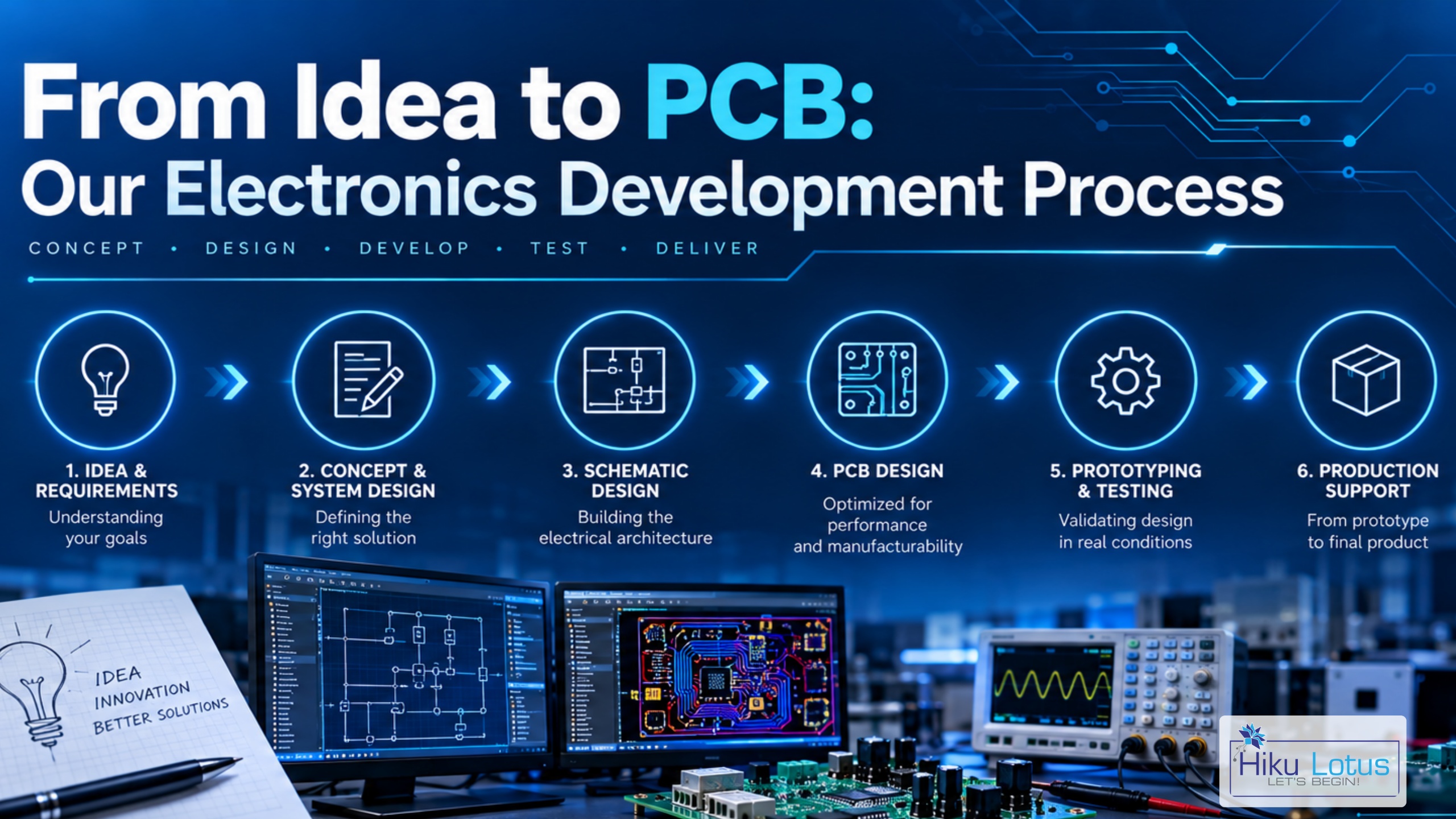
Requirements → Circuit Design → Component Selection → Stack-Up → PCB Layout → Prototype → Testing → Production
Early material selection helps engineers optimize the PCB design for performance, reliability, and manufacturability.
Why Choose Hiku Lotus for PCB Design?
At Hiku Lotus, PCB material selection is considered as part of the complete electronics engineering process. Our team evaluates the application requirements and helps select appropriate PCB materials, stack-ups, and design approaches for reliable product performance.
Our PCB and electronics design capabilities include:
- PCB Schematic Design
- PCB Layout Design
- Multilayer PCB Design
- High-Speed PCB Design
- Embedded Hardware Design
- Industrial Control Electronics
- IoT Hardware Development
- Power Electronics Design
- Prototype Development
- Design Verification
- DFM & DFT Review
- Electronics Product Development
Whether you are developing an industrial controller, IoT device, embedded system, automation equipment, or a specialized electronic product, Hiku Lotus can help you make the right PCB material and design decisions.
Conclusion
Selecting the right PCB material is an important part of developing a reliable electronic product. The ideal material depends on several factors, including operating temperature, signal frequency, thermal requirements, mechanical conditions, environmental exposure, manufacturing capability, and project cost.
While standard FR-4 is suitable for many applications, specialized materials such as high-Tg laminates, polyimide, high-frequency materials, metal-core PCBs, and ceramic substrates may be more appropriate for demanding applications.
The right PCB material, combined with proper circuit design, PCB layout, thermal management, and manufacturing practices, provides a strong foundation for a reliable and high-performance electronic product.
Talk to Hiku Lotus About Your PCB Material & Design Requirements
Not sure which PCB material is right for your application? Hiku Lotus can help you select the appropriate PCB material based on electrical performance, thermal requirements, mechanical conditions, and manufacturing needs. Get in touch with our team to discuss your PCB design and electronics development requirements.
Frequently Asked Questions (FAQs)
What is the most commonly used PCB material?
FR-4 is one of the most widely used PCB substrate materials because it provides a good balance of electrical performance, mechanical strength, manufacturability, and cost.
Is FR-4 suitable for all PCB applications?
No. FR-4 works well for many general-purpose electronics, but high-frequency, high-temperature, flexible, and high-power applications may require specialized PCB materials.
What is High-Tg PCB material?
High-Tg PCB materials are designed to maintain better mechanical and thermal performance at elevated temperatures compared with standard materials.
Which PCB material is suitable for high-frequency applications?
High-frequency PCB laminates with suitable dielectric properties and low signal loss are generally considered for RF, microwave, and high-speed applications.
When should I use a metal-core PCB?
Metal-core PCBs are useful when thermal management is a major concern, such as in high-power LED systems and certain power electronics applications.
How does PCB material affect signal integrity?
Material properties such as dielectric constant, dissipation factor, layer spacing, and material consistency can influence impedance, propagation characteristics, and signal loss.
Can Hiku Lotus help select the right PCB material?
Yes. Hiku Lotus can evaluate your application’s electrical, thermal, mechanical, environmental, and manufacturing requirements and help determine an appropriate PCB material and design approach.