The Industrial Internet of Things (IIoT) is revolutionizing how industries monitor equipment, manage operations, and optimize production. By connecting machines, sensors, and control systems through intelligent networks, IoT solutions provide real-time visibility, predictive insights, and remote control capabilities that enhance productivity and operational efficiency.
From manufacturing plants and energy facilities to water treatment systems and smart infrastructure, IoT is becoming a critical component of modern industrial automation. Businesses that adopt IoT technologies gain better control over their assets, reduce downtime, and make data-driven decisions.
In this blog, we’ll explore how IoT solutions for industrial monitoring and control are transforming industries, their key components, benefits, applications, challenges, and future trends.
What is Industrial IoT (IIoT)?
The Industrial Internet of Things (IIoT) refers to the integration of industrial equipment, sensors, controllers, and cloud platforms through secure communication networks. These connected devices collect, transmit, and analyze real-time data, enabling intelligent monitoring and automated control of industrial processes.
Unlike consumer IoT, IIoT focuses on reliability, safety, scalability, and real-time performance in demanding industrial environments.
Why IoT is Essential for Industrial Monitoring
Traditional industrial systems often rely on manual inspections and isolated control systems, making it difficult to detect issues early or optimize operations.
IoT solutions address these challenges by providing:
- Real-time equipment monitoring
- Remote access and control
- Continuous data collection
- Automated alerts and notifications
- Predictive maintenance
- Energy optimization
- Improved operational visibility
- Data-driven decision-making
These capabilities help industries reduce costs while improving productivity and reliability.
Key Components of an Industrial IoT Solution
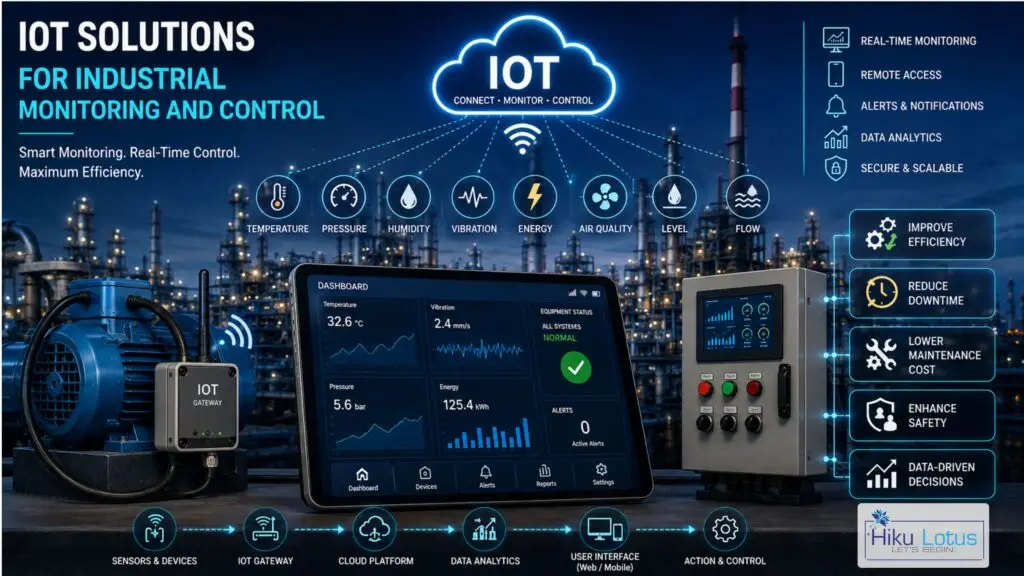
A complete IoT monitoring and control system typically includes:
Sensors
Sensors collect real-time operational data such as:
- Temperature
- Pressure
- Humidity
- Vibration
- Flow Rate
- Current & Voltage
- Tank Levels
- Gas Detection
- Machine Position
Accurate sensor data forms the foundation of every IoT solution.
Embedded Controllers
Embedded systems process sensor data and control industrial equipment.
Common controller platforms include:
- ARM Cortex-M Microcontrollers
- STM32
- ESP32
- Microchip PIC
- AVR Controllers
- Raspberry Pi (Industrial Gateway Applications)
These controllers perform local processing before transmitting data to higher-level systems.
Communication Technologies
Reliable communication is essential for industrial IoT.
Common communication protocols include:
- MQTT
- Modbus RTU/TCP
- RS-485
- CAN Bus
- Ethernet/IP
- Wi-Fi
- Bluetooth Low Energy (BLE)
- Zigbee
- LoRa & LoRaWAN
- NB-IoT
- 4G/5G Cellular Networks
The choice depends on range, bandwidth, power consumption, and application requirements.
Cloud Platform
Cloud platforms provide:
- Secure data storage
- Remote monitoring
- Historical data analysis
- Dashboard visualization
- User management
- Alert notifications
- Multi-site monitoring
Cloud integration allows businesses to monitor operations from anywhere in the world.
Dashboard & Mobile Applications
Operators and managers can access:
- Live machine status
- Equipment health
- Alarm notifications
- Production reports
- Energy consumption
- Historical trends
These dashboards improve decision-making through intuitive data visualization.
Applications of IoT in Industrial Monitoring and Control
Manufacturing Plants
IoT enables manufacturers to monitor:
- Machine health
- Production output
- Equipment utilization
- Downtime
- Product quality
Real-time monitoring improves productivity and reduces production losses.
Industrial Automation
Connected automation systems support:
- Process control
- Conveyor monitoring
- Motor control
- Valve automation
- PLC integration
- SCADA connectivity
IoT adds greater intelligence and visibility to existing automation systems.
Energy Management
IoT solutions monitor:
- Electrical consumption
- Solar power generation
- Battery performance
- Power quality
- Load balancing
This helps organizations optimize energy usage and reduce operating costs.
Water & Wastewater Management
IoT systems automate:
- Water level monitoring
- Pump control
- Leak detection
- Flow measurement
- Water quality monitoring
Remote monitoring minimizes maintenance and ensures efficient resource management.
Oil & Gas Industry
Applications include:
- Pipeline monitoring
- Pressure monitoring
- Tank level measurement
- Gas leak detection
- Remote asset management
IoT improves safety while reducing manual inspections.
Smart Agriculture
Industrial IoT helps monitor:
- Soil moisture
- Weather conditions
- Irrigation systems
- Greenhouse environments
- Livestock tracking
Automation improves crop yield and conserves resources.
Building Management Systems
IoT solutions control:
- HVAC systems
- Lighting
- Access control
- Fire safety
- Energy monitoring
Smart buildings enhance comfort while reducing energy consumption.
Benefits of IoT Solutions
Organizations implementing industrial IoT experience numerous advantages.
Real-Time Monitoring
Access live operational data from machines and equipment anytime.
Reduced Downtime
Predictive maintenance identifies potential failures before they impact production.
Improved Productivity
Continuous monitoring optimizes machine utilization and production efficiency.
Lower Maintenance Costs
Condition-based maintenance reduces unnecessary servicing.
Remote Control
Operators can monitor and manage systems from remote locations.
Better Decision-Making
Historical data and analytics provide valuable insights for process improvement.
Enhanced Safety
Historical data and analytics provide valuable insights for process improvement.
Scalability
IoT platforms can easily expand as business operations grow.
Challenges in Industrial IoT Implementation
While IoT offers significant benefits, successful implementation requires addressing challenges such as:
- Cybersecurity risks
- Legacy system integration
- Network reliability
- Data management
- Device interoperability
- Environmental conditions
- Initial deployment costs
Proper system architecture and secure communication protocols are essential for long-term success.
Future Trends in Industrial IoT
Industrial IoT continues to evolve with emerging technologies such as:
- Artificial Intelligence (AI)
- Edge Computing
- Digital Twins
- 5G Connectivity
- Autonomous Robotics
- Advanced Data Analytics
- Cloud-Native Industrial Platforms
- AI-Based Predictive Maintenance
These technologies will enable even smarter, faster, and more autonomous industrial operations.
Why Choose Hiku Lotus for Industrial IoT Solutions?
At Hiku Lotus, we develop custom IoT solutions that help industries monitor, control, and optimize their operations with confidence. Our engineering expertise combines electronics, embedded systems, connectivity, and cloud integration to deliver scalable, production-ready solutions.
Our IoT capabilities include:
- Industrial IoT Solution Development
- Embedded Hardware Design
- Embedded Firmware Development
- Custom PCB Design
- Sensor Integration
- Industrial Monitoring Systems
- Remote Control Solutions
- IoT Gateway Development
- Cloud Connectivity
- Dashboard & Data Visualization
- Prototype Development
- Electronics Product Development
Whether you’re building a smart factory, monitoring remote assets, or developing a connected industrial product, Hiku Lotus delivers reliable and customized IoT solutions tailored to your business needs.
Conclusion
IoT solutions are transforming industrial monitoring and control by providing real-time insights, remote access, predictive maintenance, and intelligent automation. As industries continue to embrace digital transformation, IIoT is becoming an essential technology for improving productivity, reducing costs, and enhancing operational reliability.
Businesses that invest in IoT today are better equipped to build smarter, safer, and more efficient operations for the future.
If you’re looking for custom Industrial IoT solutions, Hiku Lotus offers end-to-end expertise in embedded systems, PCB design, firmware development, industrial automation, and connected product engineering.
Talk to Hiku Lotus About Your Industrial IoT Project
From concept and hardware design to embedded firmware, cloud connectivity, and deployment, Hiku Lotus provides end-to-end Industrial IoT solutions. Get in touch with our team to discuss your requirements.
Frequently Asked Questions (FAQs)
What is Industrial IoT (IIoT)?
Industrial IoT (IIoT) is the use of connected sensors, embedded systems, communication networks, and cloud platforms to monitor and control industrial equipment in real time.
What are the benefits of IoT in industrial monitoring?
IoT enables real-time monitoring, predictive maintenance, remote access, improved efficiency, reduced downtime, enhanced safety, and better decision-making.
Which communication protocols are commonly used in Industrial IoT?
Common protocols include MQTT, Modbus, RS-485, CAN Bus, Ethernet/IP, Wi-Fi, BLE, Zigbee, LoRaWAN, NB-IoT, and 4G/5G cellular networks.
How does IoT help reduce maintenance costs?
By continuously monitoring equipment health, IoT systems detect early signs of wear or failure, allowing maintenance to be scheduled before costly breakdowns occur.
How does IoT help reduce maintenance costs?
By continuously monitoring equipment health, IoT systems detect early signs of wear or failure, allowing maintenance to be scheduled before costly breakdowns occur.
Does Hiku Lotus provide Industrial IoT solutions?
Yes. Hiku Lotus develops custom Industrial IoT solutions, including embedded hardware and firmware, PCB design, sensor integration, cloud connectivity, industrial monitoring systems, and automation solutions.