Turning an electronics idea into a successful commercial product requires much more than designing a circuit and manufacturing a PCB. A successful product development process involves concept development, electronic design, PCB development, embedded firmware, prototyping, testing, optimization, and production preparation.
The journey from a prototype to a production-ready product can involve many technical and engineering challenges. A design that works successfully in a prototype may still require significant improvements before it is ready for reliable, scalable manufacturing.
This is why a structured electronics product development process is essential.
In this blog, we explore the key stages involved in taking an electronic product from prototype to production, the challenges businesses commonly face, and how an experienced engineering partner can help bring products to market faster and more reliably.
What is Electronics Product Development?
Electronics product development is the complete engineering process of transforming an idea, requirement, or concept into a functional and manufacturable electronic product.
It can involve:
- Product concept development
- Electronic circuit design
- Schematic development
- PCB design and layout
- Component selection
- Embedded firmware development
- Mechanical integration
- Prototype development
- Testing and validation
- Design optimization
- Manufacturing preparation
- Production support
The goal is to create a product that is not only functional but also reliable, manufacturable, cost-effective, and scalable.
Why the Prototype-to-Production Process Matters
A prototype demonstrates that an idea can work. A production-ready product must go much further.
It needs to be:
- Reliable
- Safe
- Manufacturable
- Cost-effective
- Testable
- Serviceable
- Scalable
- Suitable for its operating environment
Many products require multiple design iterations before reaching production.
A structured development process helps identify problems early and reduces expensive changes later in the project.
Stage 1: Understanding the Product Requirements
Every successful electronics product begins with clearly defined requirements.
The development team needs to understand:
- What the product needs to do
- Who will use it
- Operating environment
- Input and output requirements
- Power requirements
- Communication requirements
- Physical dimensions
- Expected production quantity
- Target cost
- Regulatory requirements
For example, an industrial controller may need to operate continuously in an electrically noisy environment, while a battery-powered IoT device may prioritize low power consumption and wireless connectivity.
Clearly defined requirements provide the foundation for the entire development process.
Stage 2: Concept and Feasibility
Before committing significant resources to development, the proposed solution should be evaluated for technical and commercial feasibility.
The feasibility stage may consider:
- Available technologies
- Component availability
- Estimated development cost
- Manufacturing complexity
- Product size
- Power requirements
- Technical risks
- Expected production volume
A proof-of-concept may also be developed to validate the most critical technical aspects.
Early feasibility analysis can prevent costly design changes later.
Stage 3: Electronic Circuit Design
Once the concept is approved, engineers develop the electronic architecture and schematic.
This stage may include:
- Microcontroller selection
- Power supply design
- Sensor interfaces
- Communication interfaces
- Driver circuits
- Protection circuits
- Analog and digital circuits
- Input/output interfaces
The circuit should be designed according to the product’s functional and environmental requirements.
Good circuit design provides a strong foundation for the PCB and firmware development stages.
Stage 4: Component Selection
Component selection has a major impact on product reliability, cost, and production availability.
Engineers should evaluate:
- Electrical specifications
- Temperature ratings
- Package type
- Lifecycle status
- Availability
- Lead times
- Cost
- Alternate components
Component availability has become an important consideration in modern electronics development.
Designing with suitable alternatives can reduce supply-chain risks and production interruptions.
Stage 5: PCB Design and Layout
After schematic development, the circuit is converted into a physical PCB layout.
PCB design involves:
- Component placement
- Signal routing
- Power distribution
- Ground planes
- Thermal management
- EMI considerations
- High-speed routing
- Design Rule Checks
- Design for Manufacturability
The PCB must meet both electrical and mechanical requirements.
For high-performance applications, factors such as signal integrity, impedance control, thermal performance, and electromagnetic compatibility become particularly important.
Stage 6: Embedded Firmware Development
Many modern electronic products require firmware to control the hardware.
Firmware may manage:
- Sensors
- Displays
- Motors
- Relays
- Communication interfaces
- User inputs
- Data logging
- Safety functions
Depending on the product, firmware may use bare-metal programming or an RTOS-based architecture.
Hardware and firmware development should happen together wherever possible to ensure proper integration.
Stage 7: Prototype Development
The first working prototype is built to verify the design in real hardware.
Prototype development helps identify:
- Hardware design issues
- PCB layout problems
- Firmware issues
- Mechanical conflicts
- Power consumption problems
- Communication issues
- Thermal concerns
A prototype is not necessarily the final product. It is an important learning stage that provides valuable information for further refinement.
Stage 8: Testing and Validation
Testing determines whether the product performs according to its requirements.
Testing may include:
Functional Testing
Verifies that all product functions work correctly.
Electrical Testing
Checks:
- Voltage levels
- Current consumption
- Power supply stability
- Signal quality
Thermal Testing
Evaluates product performance under different temperature conditions.
Environmental Testing
Depending on the application, this may include:
- Temperature cycling
- Humidity
- Vibration
- Shock
- Dust exposure
Communication Testing
Verifies interfaces such as:
- UART
- RS-485
- CAN
- Ethernet
- Wi-Fi
- Bluetooth
- Other application-specific protocols
Testing helps identify weaknesses before production.
Stage 9: Design Optimization
Prototype testing often reveals areas that can be improved.
Optimization may include:
- Reducing PCB size
- Lowering component cost
- Improving thermal performance
- Reducing power consumption
- Improving signal integrity
- Simplifying assembly
- Improving reliability
- Replacing difficult-to-source components
This stage is sometimes called Design for Optimization or part of the engineering validation process.
The objective is to create a product that performs reliably while remaining practical to manufacture.
Stage 10: Design for Manufacturability (DFM)
A prototype may be assembled manually or in small quantities. Production requires a design optimized for manufacturing.
DFM considerations include:
- Component placement
- PCB panelization
- Assembly process
- Soldering requirements
- Component spacing
- Test access
- Manufacturing tolerances
- Production equipment
Designing for manufacturing from the beginning can reduce production costs and improve manufacturing yield.
Stage 11: Design for Testability (DFT)
Production testing becomes increasingly important as product volumes increase.
The PCB can include:
- Test points
- Programming interfaces
- Diagnostic connectors
- Automated test access
- Status indicators
DFT makes it easier to verify every manufactured unit before it reaches the customer.
Stage 12: Compliance and Certification
Depending on the product and target market, electronic products may need to meet applicable regulatory and industry requirements.
Requirements can vary based on:
- Product category
- Country or market
- Operating environment
- Wireless functionality
- Safety requirements
Compliance considerations should be incorporated into the design early rather than treated as a final-stage activity.
Stage 13: Pilot Production
Before full-scale production, a limited production batch can be manufactured.
Pilot production helps verify:
- Manufacturing processes
- Assembly procedures
- Test procedures
- Component availability
- Production yield
- Product consistency
It provides an opportunity to identify manufacturing issues before increasing production volume.
Stage 14: Moving to Mass Production
Once the design and manufacturing processes are validated, the product can move toward regular production.
Production activities may include:
- PCB fabrication
- PCB assembly
- Firmware programming
- Functional testing
- Final assembly
- Quality inspection
- Packaging
Production documentation should be controlled carefully to ensure every manufacturing batch follows the approved design.
Common Challenges in Electronics Product Development
Businesses developing electronic products often face challenges such as:
Component Availability
A component selected during prototyping may become difficult to source during production.
Prototype-to-Production Differences
A prototype may work perfectly but require redesign for automated manufacturing.
Thermal Problems
Heat generation may become more significant during continuous operation.
EMI and EMC Issues
Unexpected electromagnetic interference can appear during testing.
Firmware-Hardware Integration
Hardware and firmware may require multiple iterations before achieving stable operation.
Cost Optimization
A prototype can be technically successful but too expensive for the target market.
Manufacturing Yield
A design that works in small quantities may require optimization for high-volume manufacturing.
How to Reduce Product Development Risks
Several practices can significantly improve the development process.
Define Requirements Early
Clear requirements reduce misunderstandings and unnecessary redesigns.
Consider Manufacturing from the Beginning
Think about production requirements while designing the prototype.
Select Components Strategically
Consider availability, lifecycle, cost, and alternative components.
Test Continuously
Do not wait until the final prototype to discover design problems.
Maintain Documentation
Maintain controlled versions of:
- Schematics
- PCB files
- Firmware
- BOMs
- Test procedures
- Manufacturing documentation
Design for Scalability
The product should be capable of moving from prototype quantities to larger production volumes without major architectural changes.
From Idea to Production: A Complete Development Flow
A typical electronics product development process can be represented as:
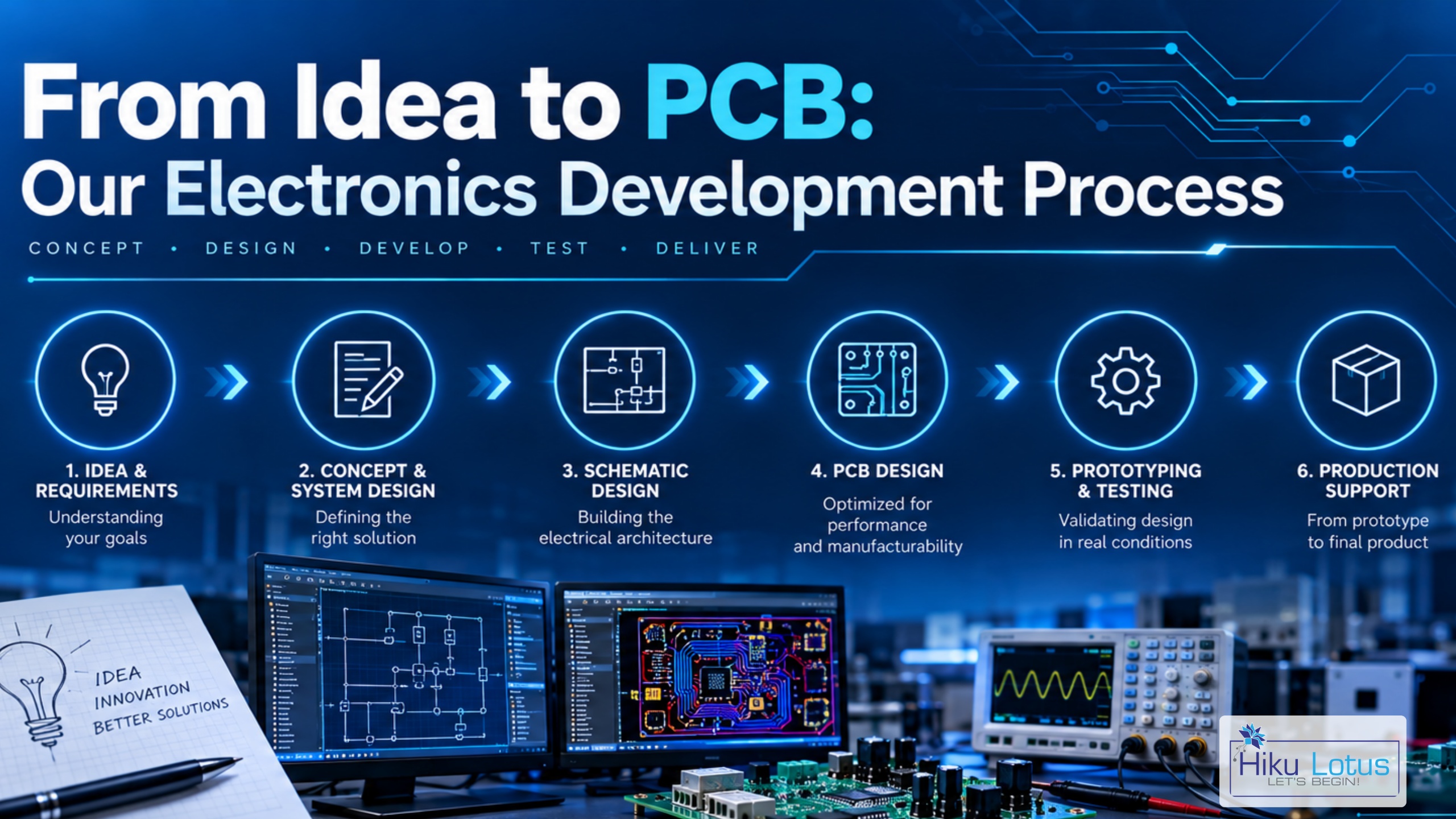
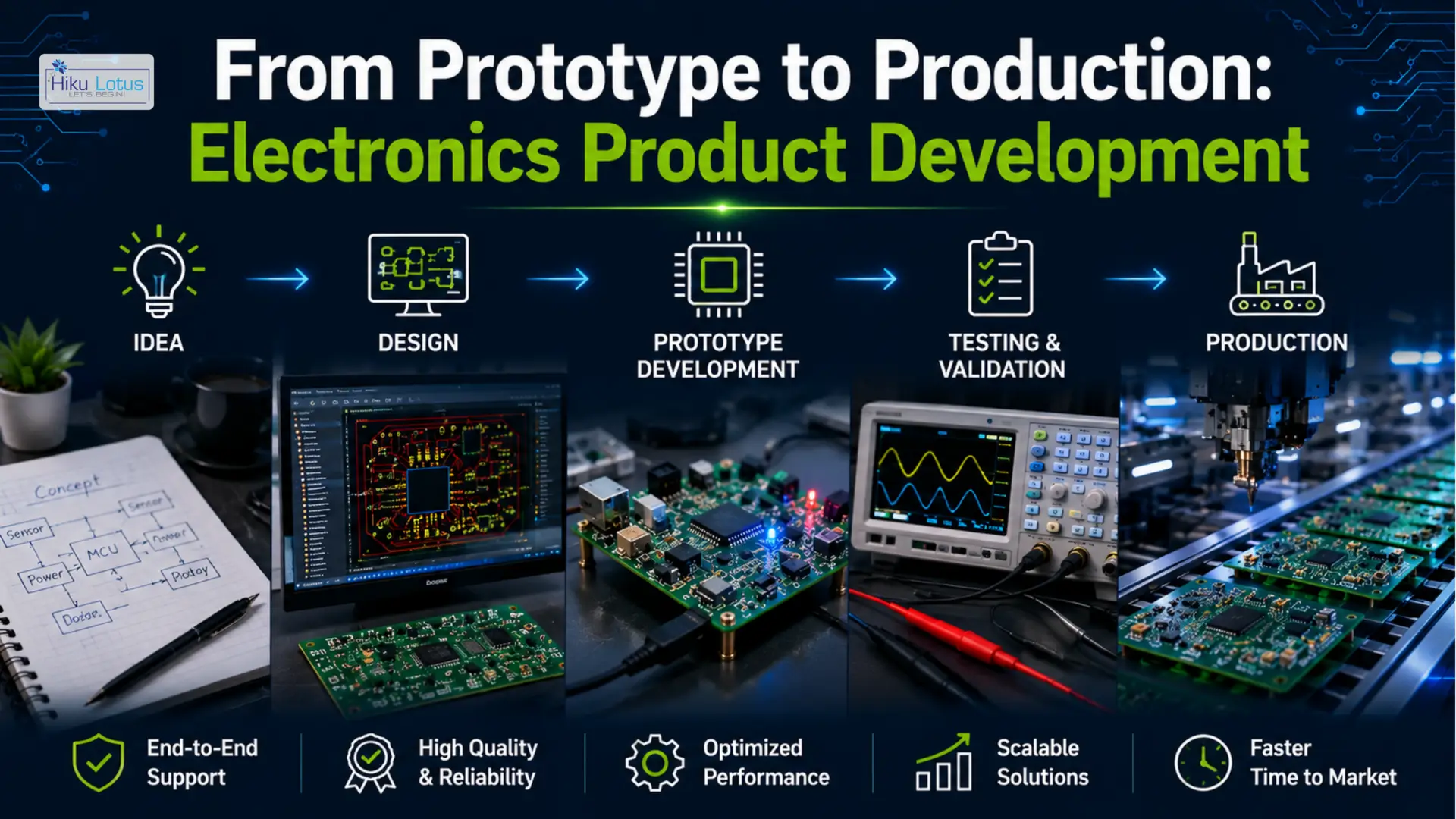
Idea → Requirements → Feasibility → Circuit Design → PCB Design → Firmware → Prototype → Testing → Optimization → DFM/DFT → Pilot Production → Mass Production
Each stage contributes to the quality and success of the final product.
Applications of Electronics Product Development
Professional electronics product development is used across many industries, including:
- Industrial Automation
- IoT & IIoT
- Consumer Electronics
- Automotive Electronics
- Medical Electronics
- Energy Management
- Robotics
- Smart Agriculture
- Security Systems
- Gaming & Amusement Systems
- Control & Monitoring Systems
- Communication Equipment
Why Choose Hiku Lotus for Electronics Product Development?
At Hiku Lotus, we provide end-to-end electronics engineering support to help transform ideas into reliable, production-ready products.
Our capabilities include:
- Product Concept Development
- Electronics Circuit Design
- Schematic Design
- PCB Design & Layout
- Embedded System Development
- Firmware Development
- Sensor & Actuator Integration
- Communication Protocol Development
- Prototype Development
- Hardware-Firmware Integration
- Testing & Validation
- DFM & DFT Support
- Product Optimization
- Manufacturing Support
Our integrated approach allows hardware, PCB, firmware, and system-level requirements to be considered together throughout the development process.
Whether you are starting with an idea, an existing prototype, or a partially developed product, Hiku Lotus can help move your project toward a reliable and scalable production solution.
Conclusion
Taking an electronic product from prototype to production requires careful planning, engineering, testing, and optimization. A successful prototype is only the beginning—the final product must also be reliable, manufacturable, cost-effective, testable, and ready for scale.
By following a structured product development process, businesses can reduce technical risks, improve product quality, and accelerate the journey from concept to market.
With expertise across electronics design, PCB development, embedded systems, firmware, prototyping, testing, and manufacturing support, Hiku Lotus can help businesses turn innovative ideas into dependable electronic products.
Talk to Hiku Lotus About Your Electronics Product Development Project
Have an electronics product idea, working prototype, or existing design that needs to move toward production? Hiku Lotus provides end-to-end electronics product development support, from circuit and PCB design to embedded firmware, prototyping, testing, optimization, and manufacturing support. Get in touch with our team to discuss your requirements and take your product from prototype to production.
Frequently Asked Questions (FAQs)
What is electronics product development?
Electronics product development is the complete process of transforming an electronic concept or requirement into a tested, reliable, manufacturable, and production-ready product.
What are the main stages of electronics product development?
The main stages include requirements definition, feasibility, circuit design, component selection, PCB design, firmware development, prototyping, testing, optimization, DFM/DFT, pilot production, and mass production.
Why is prototyping important in electronics development?
Prototyping allows engineers to validate the hardware, firmware, functionality, mechanical integration, thermal performance, and other important product requirements before moving into production.
What is DFM in electronics product development?
DFM stands for Design for Manufacturability. It involves optimizing the product and PCB design so that it can be manufactured efficiently, consistently, and cost-effectively.
How can I move an existing prototype to production?
An existing prototype should be evaluated for electrical performance, reliability, component availability, PCB manufacturability, testing requirements, compliance, cost, and production scalability before entering pilot or mass production.
Does Hiku Lotus provide complete electronics product development?
Yes. Hiku Lotus provides end-to-end electronics product development services covering circuit design, PCB design, embedded systems, firmware, prototyping, testing, optimization, DFM/DFT, and manufacturing support.