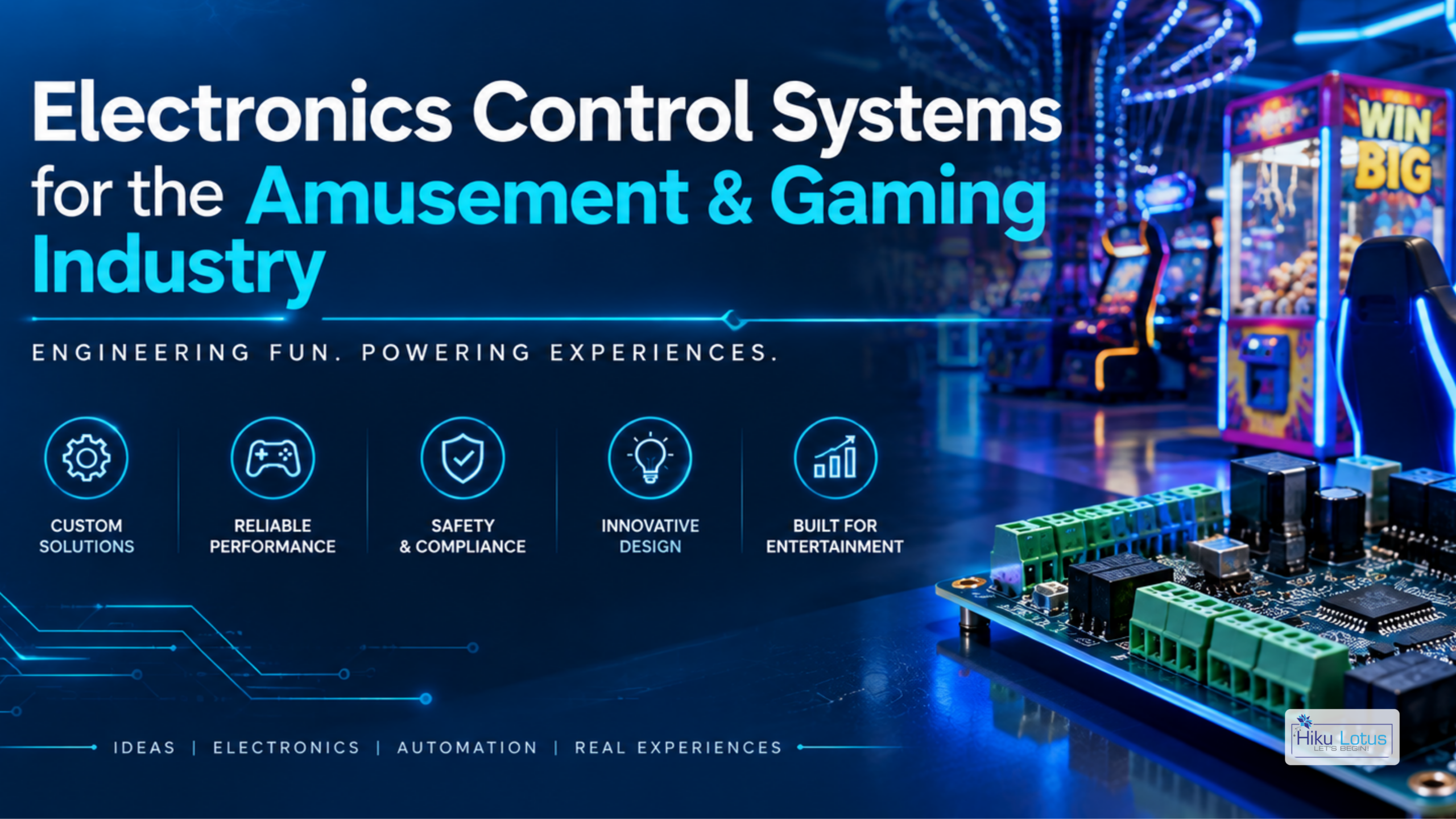
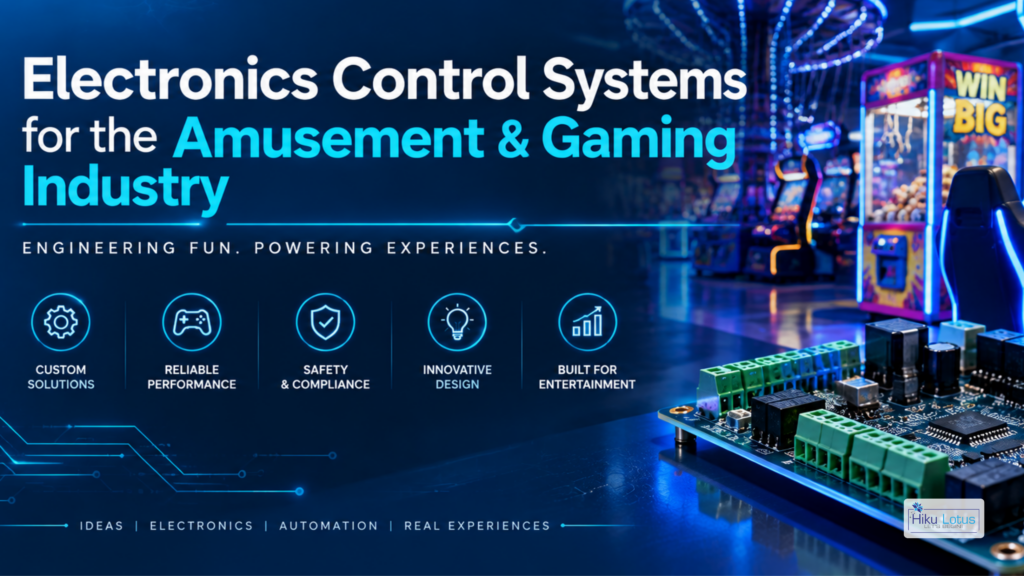
The amusement and gaming industry depends on technology to deliver safe, engaging, reliable, and interactive experiences. Behind modern amusement rides, arcade machines, gaming equipment, interactive attractions, simulators, and entertainment systems are sophisticated electronics control systems that manage motion, lighting, sound, user inputs, sensors, safety functions, and real-time operations.
As entertainment equipment becomes more automated and connected, traditional electrical controls are increasingly being replaced or enhanced by microcontroller-based electronics, embedded systems, PLCs, communication interfaces, sensor networks, and intelligent control platforms.
A well-designed electronics control system can improve operational reliability, enhance user experience, simplify maintenance, provide real-time monitoring, and enable manufacturers to develop differentiated amusement and gaming products.
At Hiku Lotus, we provide custom electronics engineering, embedded hardware, firmware, PCB design, industrial automation, and control-system development for specialized amusement and gaming applications.
What Are Electronics Control Systems?
An electronics control system is a combination of electronic hardware, embedded software, sensors, actuators, communication interfaces, and control logic designed to monitor and control a machine or system.
In amusement and gaming equipment, a control system may perform functions such as:
- Motor and actuator control
- Sensor monitoring
- User-input processing
- Safety interlocks
- LED and lighting control
- Audio and sound control
- Display management
- Timing and sequencing
- Remote control
- Machine status monitoring
- Fault detection
- Data logging
- Communication with other controllers
- Automatic shutdown during abnormal conditions
Depending on the application, the control architecture may use a microcontroller, embedded processor, PLC, industrial controller, or a combination of these technologies.
Why Electronics Control Systems Are Important in Amusement & Gaming
Amusement and gaming equipment operates in environments where reliability, response time, safety, and user experience are critical.
A control system must not only perform its intended function but also respond correctly to unexpected events.
For example, an amusement ride controller may need to:
- Receive a start command.
- Check safety conditions.
- Confirm sensor status.
- Activate actuators or motors.
- Monitor the system continuously.
- Detect abnormal conditions.
- Stop the system when required.
- Provide status information to the operator.
Similarly, a gaming or interactive entertainment system may need to process multiple buttons, sensors, displays, LEDs, audio outputs, timers, and communication interfaces simultaneously.
This makes the electronics control system one of the most important parts of the overall equipment.
Key Components of an Amusement & Gaming Control System
A complete control system typically consists of multiple hardware and software elements.
1. Microcontrollers and Embedded Processors
Microcontrollers are widely used for dedicated control applications because they provide:
- Real-time processing
- Digital and analog inputs
- PWM outputs
- Communication interfaces
- Timers and counters
- Low power consumption
- Compact PCB implementation
- Programmable control logic
Depending on the application, controllers based on ARM, AVR, ESP32, STM32, or other MCU platforms can be selected.
The appropriate controller depends on processing requirements, I/O count, communication requirements, memory, operating environment, and product cost.
2. Sensors and Inputs
Sensors provide the control system with information about the equipment and its environment.
Common inputs can include:
- Proximity sensors
- Position sensors
- Limit switches
- Optical sensors
- Temperature sensors
- Pressure sensors
- Speed sensors
- Encoders
- Current sensors
- Emergency switches
- Door and access sensors
- Player or user inputs
Accurate sensor processing is particularly important for equipment involving motion, sequencing, or safety monitoring.
3. Motor and Actuator Control
Many amusement machines and attractions involve motors, solenoids, pneumatic systems, linear actuators, or other moving mechanisms.
Electronic control systems can manage:
- DC motors
- BLDC motors
- Stepper motors
- Servo motors
- Solenoid valves
- Linear actuators
- Relays and contactors
Motor control electronics may include drivers, MOSFETs, IGBTs, relays, current monitoring, feedback systems, and protection circuits.
For high-power applications, the low-voltage control electronics can be electrically isolated from the power stage to improve safety and reliability.
4. LED and Lighting Control
Lighting plays a major role in creating immersive amusement and gaming experiences.
Modern equipment may use hundreds or thousands of LEDs for:
- Decorative lighting
- Game indicators
- Interactive effects
- Ride lighting
- Score indicators
- Player feedback
- Animations
- Attraction displays
Control systems can synchronize lighting patterns with:
- Game events
- Ride movements
- Music
- User interaction
- Timers
- Machine states
Addressable LEDs and dedicated LED drivers can be integrated into custom electronics platforms to create sophisticated lighting effects.
5. Display and User Interface Control
Gaming and amusement equipment often requires a user interface for players and operators.
This may include:
- Seven-segment displays
- LCD displays
- TFT displays
- Touchscreens
- Push buttons
- Joysticks
- Rotary encoders
- Keypads
- Indicator LEDs
- Operator control panels
The controller processes user inputs and generates appropriate visual and operational feedback.
For example, a gaming machine may display:
Credits → Game Selection → Countdown → Game Result → Score → Reset
All of these functions can be managed through embedded control software.
6. Audio and Sound Integration
Sound is another important part of the entertainment experience.
Embedded electronics can interface with:
- Audio amplifiers
- Speakers
- DFPlayer-type modules
- Digital audio systems
- External sound processors
- Trigger-based sound systems
The controller can trigger sounds based on events such as:
- System startup
- Game start
- Player interaction
- Winning conditions
- Warning conditions
- Ride sequences
- Game completion
Synchronizing sound, lighting, motion, and visual effects can significantly improve the overall experience.
7. Communication Interfaces
Modern amusement and gaming systems frequently require communication between multiple electronic modules.
Common interfaces include:
- UART
- RS-232
- RS-485
- CAN
- SPI
- I²C
- Ethernet
- Wi-Fi
- Bluetooth / BLE
- RF communication
For example, a central controller could communicate with separate modules responsible for:
Motion → Lighting → Audio → Display → Sensors → Operator Panel
A modular architecture can simplify development, troubleshooting, and future upgrades.
8. Safety and Interlock Systems
Safety is one of the most important considerations in amusement equipment.
Depending on the application, the control architecture may monitor:
- Emergency stop inputs
- Door or enclosure switches
- Position sensors
- Limit switches
- Motor conditions
- Over-temperature conditions
- Over-current conditions
- Sensor faults
- Communication failures
- Power abnormalities
The system can be designed so that unsafe conditions prevent operation or place the equipment into a defined safe state.
For safety-critical amusement equipment, the final architecture and implementation should be designed and validated against the applicable regulations, standards, and certification requirements for the target market.
Real-Time Control in Amusement Equipment
Many amusement applications require precise timing.
Consider an interactive attraction where:
Button Press → Sensor Detection → Motor Movement → LED Effect → Sound → Display Update
must happen within a controlled sequence.
The controller must process inputs and outputs with predictable timing.
Techniques such as:
- Interrupt-driven processing
- Hardware timers
- State machines
- Real-time operating systems
- Event queues
- Watchdog timers
- Priority-based task handling
can be used to develop reliable real-time control software.
Custom PCB Design for Amusement Control Systems
A custom PCB provides the foundation for a compact and reliable control system.
PCB design considerations can include:
Power Supply Design
The board may need to convert incoming power into multiple regulated voltage rails such as:
- 24 V
- 12 V
- 5 V
- 3.3 V
Proper power architecture helps protect sensitive electronics from voltage fluctuations and electrical noise.
EMI and Noise Control
Motors, relays, switching power supplies, and LED drivers can generate electrical noise.
PCB design may therefore require:
- Proper grounding
- Power filtering
- Decoupling capacitors
- Controlled return paths
- Signal separation
- Shielding considerations
- Protection components
Thermal Management
Power components can generate significant heat.
Thermal design may include:
- Copper area optimization
- Thermal vias
- Heatsinks
- Component placement
- Airflow considerations
Protection
Depending on the environment, protection circuits may include:
- Reverse-polarity protection
- Over-voltage protection
- Over-current protection
- ESD protection
- Surge protection
- Short-circuit protection
Firmware Development for Amusement & Gaming Equipment
Hardware alone cannot provide intelligent control. Firmware defines how the equipment behaves.
Custom firmware can manage:
- Startup sequences
- User inputs
- Sensor processing
- Timing
- Motor control
- Lighting effects
- Audio triggers
- Game logic
- Communication
- Fault handling
- Error codes
- Data logging
- System diagnostics
A well-structured firmware architecture makes it easier to modify game logic, add new features, and support future hardware revisions.
Control System Architecture
A typical amusement control system can be structured as:
User Input
↓
Sensors & Interface Electronics
↓
Main Embedded Controller
↓
Control Logic / Firmware
↓
Motor + Lighting + Audio + Display Outputs
↓
Feedback Sensors
↓
Continuous Monitoring
For larger systems, multiple controllers can communicate with a central supervisory system.
This distributed architecture can improve scalability and allow individual subsystems to be independently developed or replaced.
Applications in the Amusement Industry
Custom electronics control systems can be used in many amusement applications.
Amusement Rides
Control electronics can manage:
- Motor operation
- Ride sequences
- Position sensing
- Lighting
- Audio
- Operator controls
- Safety inputs
- Timing
Arcade Machines
Control systems can integrate:
- Buttons
- Joysticks
- Displays
- Speakers
- LEDs
- Coin/token mechanisms
- Game controllers
Interactive Attractions
Interactive systems may combine:
- Motion detection
- Sensors
- Lighting
- Audio
- Displays
- Interactive controls
- Embedded controllers
Simulators
Simulation equipment can integrate:
- Motion platforms
- Displays
- Audio
- Joysticks
- Buttons
- Sensors
- Motor controllers
Kiddie Rides
Compact embedded control systems can manage:
- Ride movement
- Timers
- Start/stop controls
- Lighting
- Sound
- Safety inputs
Applications in the Gaming Industry
Electronics control systems are equally important for gaming and entertainment equipment.
Applications include:
- Arcade gaming machines
- Redemption games
- Interactive gaming systems
- Skill-based machines
- Simulator games
- Prize machines
- Electronic game tables
- Sports gaming equipment
- Interactive entertainment installations
The electronics architecture can be customized according to the required game logic, number of players, input devices, displays, sensors, and communication requirements.
Benefits of Custom Electronics Control Systems
Improved Reliability
Purpose-built hardware and firmware can be optimized for the exact operating environment.
Faster Response
Real-time embedded processing enables fast response to user inputs and sensors.
Better User Experience
Motion, lighting, audio, displays, and interaction can be synchronized to create engaging experiences.
Reduced Wiring
Custom PCBs can combine multiple functions into compact electronic assemblies, reducing wiring complexity.
Easier Maintenance
Diagnostic features and modular designs can help technicians identify faults more quickly.
Product Differentiation
Custom electronics allow manufacturers to develop unique control features rather than relying entirely on off-the-shelf systems.
Scalability
A modular architecture can support different machine variants and future product upgrades.
Important Design Challenges
Developing electronics for amusement and gaming equipment involves several challenges.
Electrical Noise
Motors, relays, and switching devices can interfere with sensitive control electronics.
Power Fluctuations
Entertainment equipment may experience electrical disturbances caused by motors and other high-power loads.
Continuous Operation
Machines installed in commercial entertainment environments may operate for long hours and require high reliability.
Environmental Conditions
Equipment may be exposed to:
- Dust
- Humidity
- Temperature variation
- Vibration
- Frequent user interaction
Safety
Motion-based equipment requires careful consideration of fault conditions and emergency shutdown mechanisms.
Manufacturing
The electronics should be designed not only for prototype development but also for repeatable manufacturing and serviceability.
Designing for Manufacturing and Maintenance
A successful amusement control system should be designed with the complete product lifecycle in mind.
Important considerations include:
- Component availability
- PCB manufacturability
- Connector selection
- Cable management
- Service access
- Test points
- Programming interfaces
- Diagnostic LEDs
- Error reporting
- Firmware update mechanisms
- Replacement strategy
Designing for manufacturing and maintenance from the beginning can reduce production and service costs.
Smart and Connected Amusement Systems
The next generation of amusement equipment is becoming increasingly connected.
IoT and IIoT technologies can enable machines to provide:
- Remote monitoring
- Equipment status
- Error notifications
- Usage statistics
- Maintenance information
- Performance data
- Remote diagnostics
For example, a network-connected amusement machine could report:
Machine Status → Operating Hours → Fault Code → Temperature → Usage → Maintenance Requirement
to a central dashboard.
This can help operators manage multiple machines across an amusement park, gaming center, entertainment venue, or other commercial installation.
Future Trends in Amusement & Gaming Electronics
The industry is moving toward increasingly intelligent and connected systems.
Key trends include:
AI-Assisted Experiences
AI can be used to personalize interactions and analyze player behavior.
IoT Connectivity
Connected machines can provide real-time operational information.
Advanced Sensors
More sophisticated sensors can improve interaction, motion detection, and system feedback.
Edge Computing
Local processing can reduce latency and enable real-time responses without depending entirely on cloud connectivity.
Immersive Experiences
Lighting, motion, sound, displays, and interactive electronics are increasingly integrated into unified experiences.
Modular Electronics
Modular controller architectures can simplify product variants, upgrades, and maintenance.
Predictive Maintenance
Operational data can be used to identify potential equipment problems before failures occur.
How Hiku Lotus Supports Amusement & Gaming Electronics Development
At Hiku Lotus, we provide custom electronics engineering solutions for companies developing amusement, gaming, interactive, and entertainment equipment.
Our capabilities include:
- Custom electronics design
- Embedded hardware development
- PCB schematic and layout design
- Microcontroller-based control systems
- Firmware development
- Sensor integration
- Motor and actuator control
- LED and lighting control
- Display interfaces
- Audio integration
- Communication interfaces
- Wireless connectivity
- Industrial control electronics
- Prototype development
- Hardware-firmware integration
- Testing and debugging
- Product optimization
- Production support
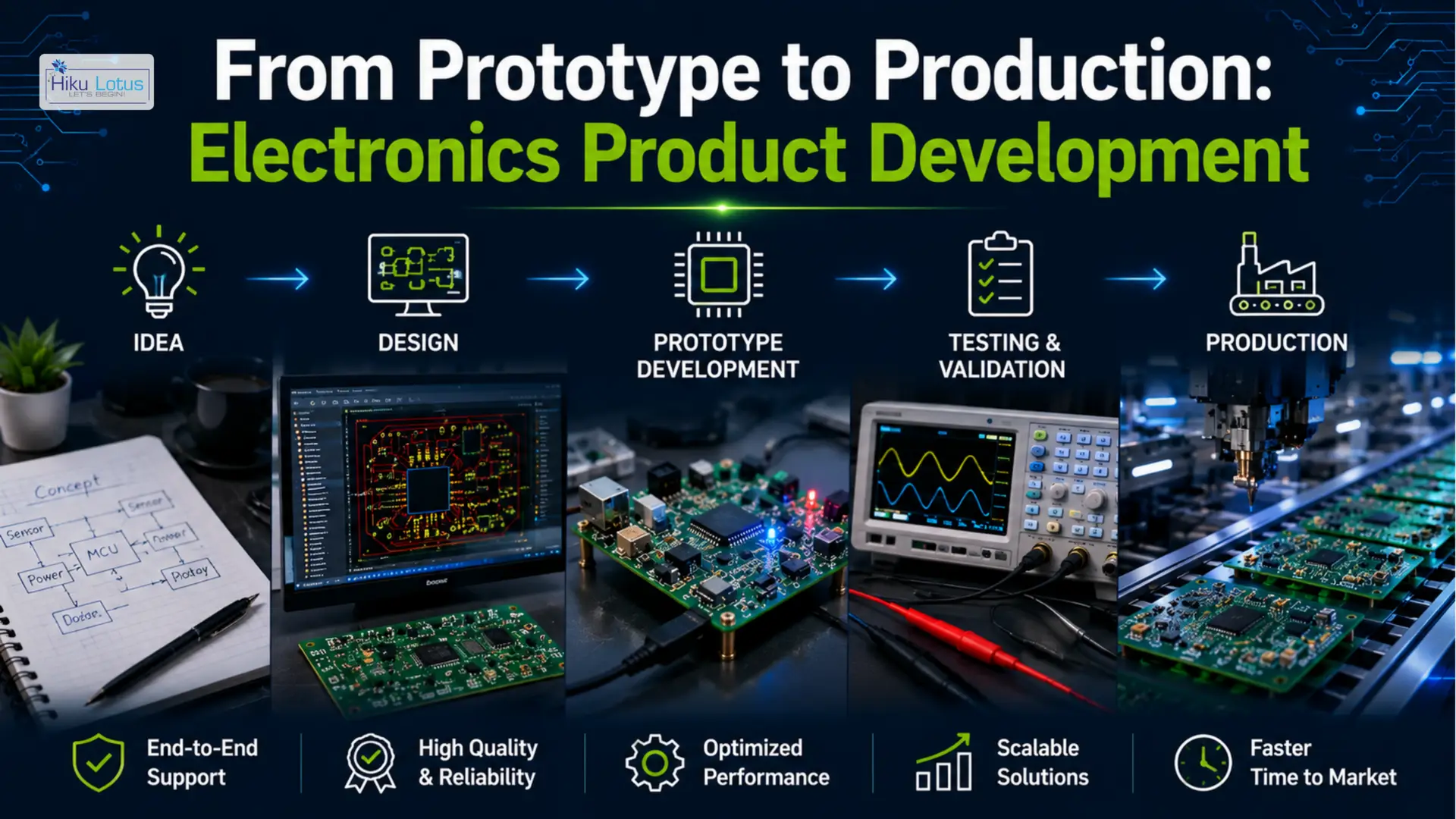
We can work with clients from the initial concept and feasibility stage through electronics design, prototyping, testing, optimization, and production support.
Conclusion
Electronics control systems are at the heart of modern amusement and gaming equipment. From controlling motors and sensors to synchronizing lighting, audio, displays, and interactive features, embedded electronics determine how effectively a machine performs and how users experience it.
As the industry moves toward smarter, connected, and more immersive entertainment systems, manufacturers need control electronics that are reliable, scalable, responsive, serviceable, and customized to their application.
With expertise in PCB design, embedded systems, firmware development, electronics engineering, automation, and control systems, Hiku Lotus can help transform amusement and gaming concepts into dependable electronic products.
Talk to Hiku Lotus About Your Amusement & Gaming Electronics Project
Have an amusement machine, gaming system, interactive attraction, or entertainment equipment that needs a custom electronics solution? Hiku Lotus provides complete electronics engineering support, from controller and PCB design to embedded firmware, sensor integration, motor control, prototyping, testing, and production support. Get in touch with our team to discuss your requirements and develop a reliable control system for your product.
Frequently Asked Questions
1. What is an electronics control system in amusement equipment?
It is a combination of electronic hardware, sensors, actuators, controllers, communication interfaces, and firmware used to monitor and control amusement equipment.
2. Can Hiku Lotus develop a custom amusement control board?
Yes. Hiku Lotus can develop custom controller PCBs based on the required inputs, outputs, sensors, communication interfaces, power requirements, and operating conditions.
3. Can the controller operate motors and actuators?
Yes. Custom electronics can be designed to interface with appropriate motor drivers, relays, contactors, solenoids, and actuator-control systems.
4. Can lighting and sound be integrated into the same control system?
Yes. Lighting, audio, displays, motion, and user inputs can be integrated into a coordinated embedded control architecture.
5. Can the system support remote monitoring?
Yes. Depending on the application, Ethernet, Wi-Fi, Bluetooth, cellular, or other communication technologies can be integrated for monitoring and diagnostics.
6. Can an existing amusement machine controller be upgraded?
Yes. Existing control electronics can potentially be redesigned or upgraded to improve reliability, add features, replace obsolete components, or introduce modern connectivity.
7. What information is required to develop a custom control system?
Important inputs include the machine’s functional requirements, power supply, sensors, actuators, motor specifications, user interfaces, communication requirements, environmental conditions, and production volume.