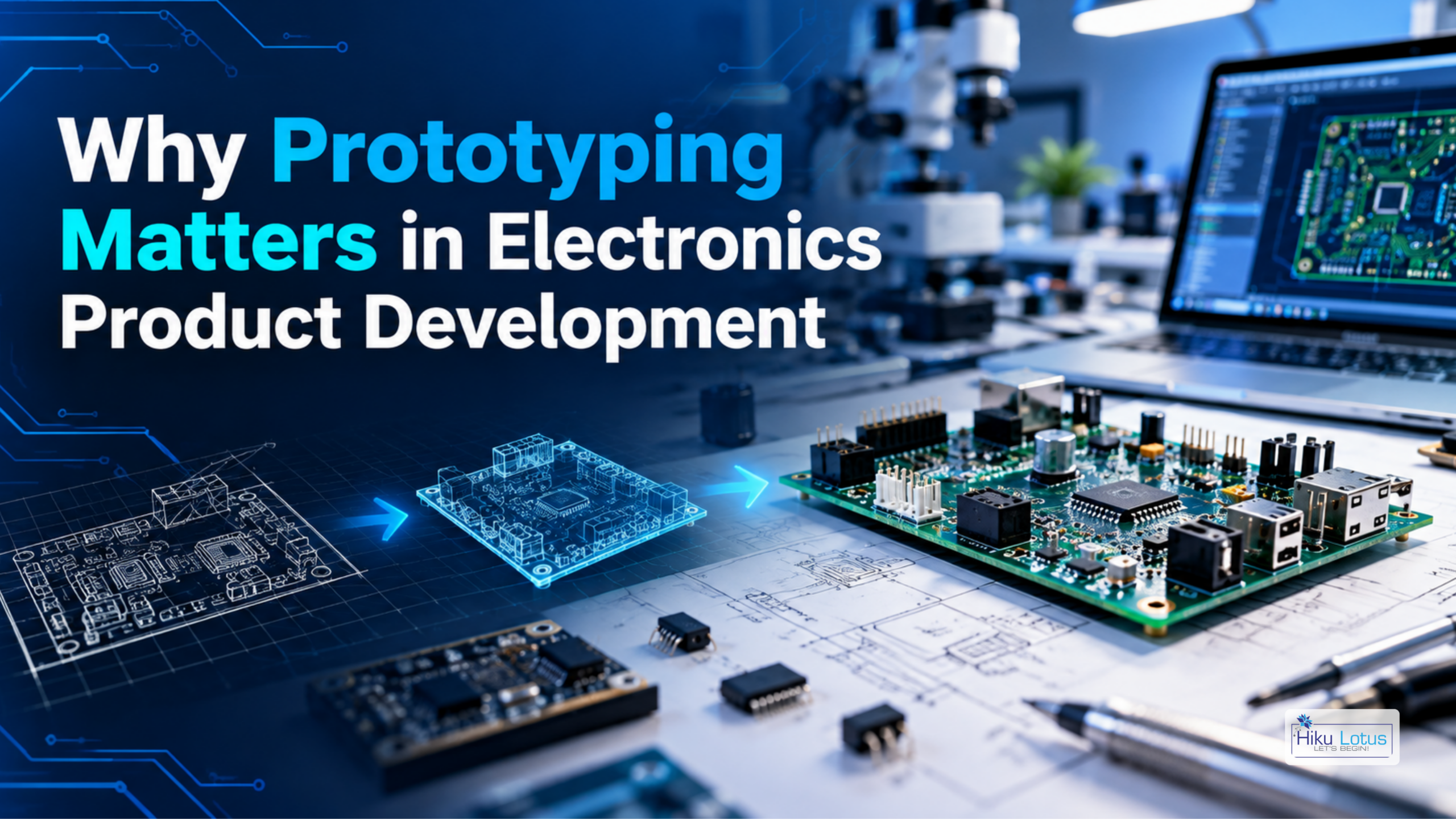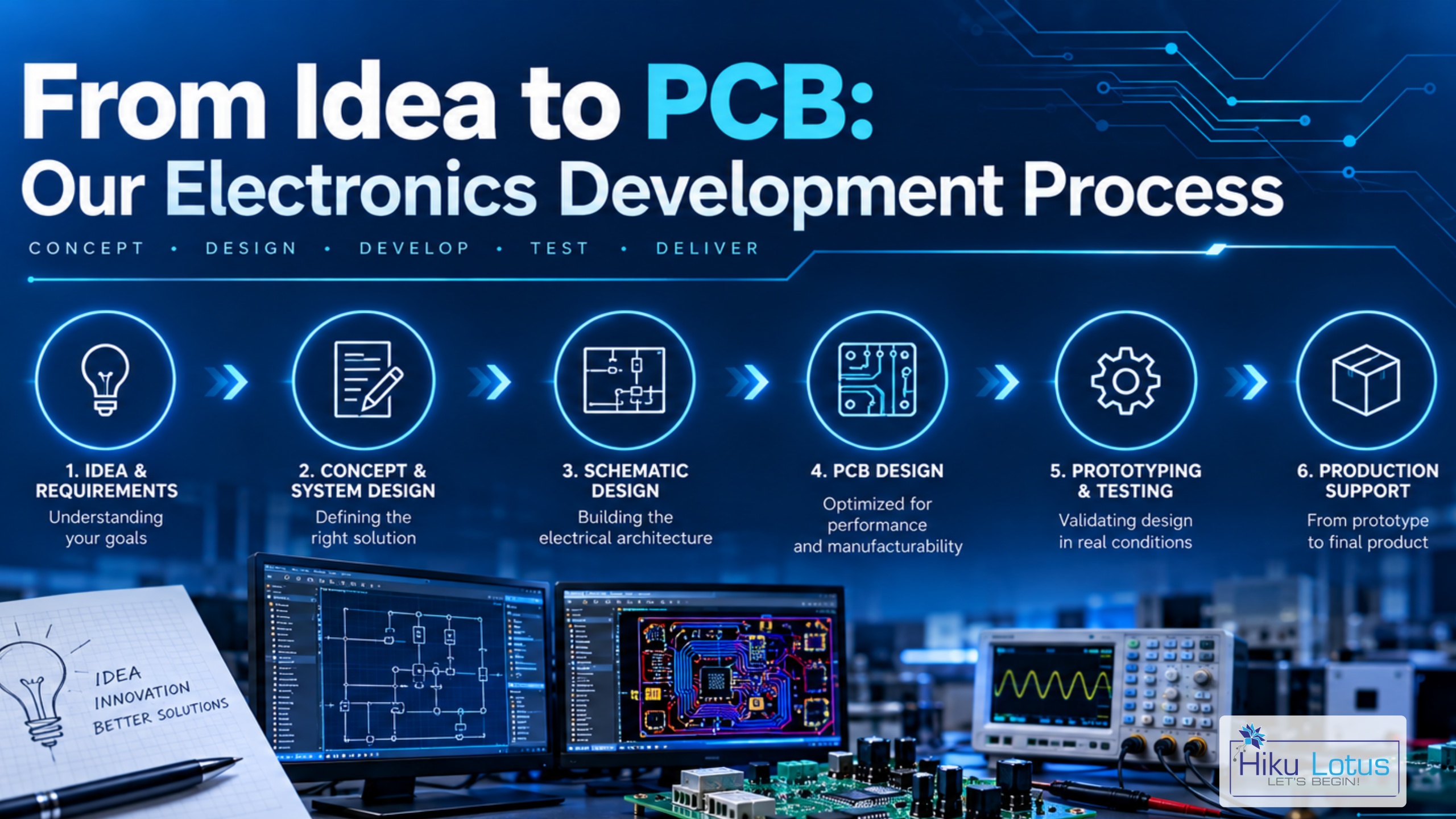
Developing a new electronic product involves many engineering decisions, from selecting components and designing circuits to developing PCBs, firmware, mechanical assemblies, and user interfaces. While simulation and design tools can help engineers predict how a product should work, building and testing a physical prototype is an essential part of electronics product development.
An electronics prototype provides an opportunity to validate the actual hardware in real operating conditions. It can reveal electrical, thermal, mechanical, firmware, communication, and usability issues before the product moves into production.
For companies developing custom electronics, embedded systems, control systems, IoT devices, industrial equipment, amusement machines, and other electronic products, prototyping can significantly improve the development process.
At Hiku Lotus, we support electronics product development from concept and circuit design through PCB prototyping, hardware-firmware integration, testing, optimization, and production support.
What Is Electronics Prototyping?
Electronics prototyping is the process of creating an early physical version of an electronic product or subsystem to verify its design and functionality.
A prototype may range from a simple proof-of-concept circuit to a fully assembled custom PCB.
Depending on the project, prototyping can involve:
- Breadboard or development-board testing
- Proof-of-concept circuits
- Custom PCB prototypes
- Sensor integration
- Microcontroller programming
- Firmware development
- Motor and actuator testing
- Communication testing
- Display and user-interface testing
- Mechanical integration
- Functional validation
The objective is to move from “the design should work” to “the design has been physically tested and validated.”
Why Prototyping Matters
A schematic and PCB layout represent the intended design, but real-world electronics can behave differently from theoretical calculations or simulations.
A prototype allows engineers to identify issues such as:
- Incorrect component selection
- Unexpected electrical noise
- Power-supply instability
- Thermal problems
- Signal-integrity issues
- Communication failures
- Firmware problems
- Mechanical interference
- Sensor inaccuracies
- Connector issues
- EMI/EMC concerns
- User-interface problems
Finding these issues during prototyping is generally less expensive and easier than discovering them after production has started.
1. Validates the Original Concept
The first purpose of a prototype is to determine whether the proposed concept works in practice.
For example, an electronics product may require:
Sensor → Microcontroller → Firmware → Motor Driver → Motor
The prototype can verify whether the complete chain performs as expected.
Testing the physical system can answer questions such as:
- Is the sensor response accurate?
- Is the controller fast enough?
- Does the firmware process inputs correctly?
- Does the motor driver provide the required output?
- Does the motor respond correctly?
- Is the system stable during continuous operation?
This provides valuable engineering feedback before the design is finalized.
2. Identifies Design Problems Early
One of the biggest advantages of prototyping is early problem detection.
A design may appear correct during schematic review but reveal problems when physically tested.
Examples include:
Power Problems
The circuit may experience voltage drops when motors or other high-current loads operate.
Thermal Problems
A regulator, MOSFET, driver, or processor may operate at a higher temperature than expected.
Signal Problems
Sensitive signals may be affected by noise from switching circuits or motors.
Communication Problems
Wireless, UART, RS-485, CAN, or other interfaces may behave differently in the actual system.
Mechanical Problems
The PCB may not fit correctly inside the intended enclosure.
Prototype testing provides an opportunity to correct these problems before production.
3. Validates the PCB Design
A PCB prototype allows engineers to verify that the physical board performs according to the design.
Important checks can include:
- Component placement
- PCB dimensions
- Connector locations
- Power distribution
- Signal routing
- Grounding
- Thermal performance
- Programming interfaces
- Test points
- Mounting holes
The prototype can also reveal whether the PCB is practical to assemble, service, and integrate into the final product.
4. Tests Hardware and Firmware Together
Modern electronics products are often a combination of hardware and software.
The PCB may provide the hardware platform, while firmware determines how the product behaves.
For example:
Sensor Input → MCU → Firmware Logic → Output Driver → Actuator
A prototype allows hardware and firmware to be developed and tested together.
This can help identify:
- Incorrect pin assignments
- Timing problems
- Interrupt issues
- Communication errors
- Sensor-processing problems
- Firmware state-machine issues
- Peripheral configuration problems
- Unexpected system interactions
Hardware-firmware integration is particularly important in embedded products.
5. Verifies Real-World Performance
Simulation can provide useful information, but physical testing provides actual performance data.
Depending on the product, engineers may measure:
- Voltage
- Current
- Power consumption
- Temperature
- Signal levels
- Communication performance
- Response time
- Motor speed
- Sensor accuracy
- Battery performance
These measurements can be compared against the original product requirements.
6. Helps Improve Component Selection
Component selection made during the initial design stage may need to be reviewed after prototype testing.
For example, testing may reveal that a component:
- Generates excessive heat
- Has insufficient current capacity
- Produces unwanted noise
- Is difficult to source
- Has inadequate accuracy
- Does not provide sufficient performance
The prototype stage provides an opportunity to evaluate alternatives before finalizing the production design.
7. Detects Power Supply and Power Management Issues
Power supply design is one of the most important areas to validate during prototyping.
A prototype can help verify:
- Input voltage range
- Regulated output voltages
- Current consumption
- Startup behavior
- Voltage drops
- Load regulation
- Switching noise
- Protection circuits
- Battery performance
For systems containing motors, relays, solenoids, LEDs, wireless modules, or other high-current loads, power behavior should be evaluated under realistic operating conditions.
8. Helps Identify Thermal Problems
Electronic components generate heat during operation.
A prototype can be used to measure temperatures of:
- Voltage regulators
- MOSFETs
- Motor drivers
- Power transistors
- Microcontrollers
- LED drivers
- DC-DC converters
Thermal testing can help determine whether the product requires:
- Larger copper areas
- Thermal vias
- Heat sinks
- Improved airflow
- Different components
- Lower operating currents
- Improved enclosure ventilation
Addressing thermal issues before production can improve long-term reliability.
9. Validates Sensors and Inputs
Many electronic products depend on sensors for accurate operation.
Prototype testing allows engineers to evaluate sensors under actual operating conditions.
Examples include:
- Proximity sensors
- Temperature sensors
- Pressure sensors
- Optical sensors
- Motion sensors
- Capacitive sensors
- Encoders
- Current sensors
- Position sensors
Testing can reveal issues such as:
- False triggering
- Electrical noise
- Sensitivity problems
- Incorrect thresholds
- Environmental interference
- Response-time limitations
Firmware and hardware parameters can then be adjusted accordingly.
10. Tests Communication Interfaces
Communication interfaces often require real-world validation.
A prototype can be used to test:
- UART
- RS-232
- RS-485
- CAN
- SPI
- I²C
- Ethernet
- Wi-Fi
- Bluetooth / BLE
- RF communication
Testing may include:
- Communication reliability
- Data integrity
- Response time
- Range
- Interference
- Error handling
- Reconnection behavior
For connected products, communication testing can be particularly important because the final operating environment may contain multiple sources of electrical or wireless interference.
11. Validates Mechanical Integration
Electronics cannot be considered independently from the mechanical product.
A PCB prototype helps verify:
- Board dimensions
- Mounting holes
- Connector accessibility
- Component height
- Cable routing
- Enclosure clearance
- Heat dissipation
- Service access
A board that works electrically but does not fit inside the final enclosure still requires redesign.
Prototype integration helps identify these issues early.
12. Improves User Experience
For products involving buttons, displays, touchscreens, LEDs, audio, or physical interaction, prototyping also provides an opportunity to evaluate usability.
Engineers can verify:
- Button locations
- Display visibility
- Indicator brightness
- Touch response
- Audio feedback
- Response time
- Control layout
- User interaction sequence
User feedback during the prototype stage can lead to practical improvements before production.
13. Reduces Production Risk
Moving directly from a theoretical design to mass production can introduce significant risk.
Prototype development provides a controlled stage between design and manufacturing.
The development path can be:
Concept → Prototype → Testing → Optimization → Production
Each stage reduces uncertainty before the next stage.
Prototype validation can help reduce the risk of:
- Large production failures
- Expensive PCB redesigns
- Component changes
- Manufacturing problems
- Firmware revisions
- Field failures
14. Supports Design Optimization
The first prototype does not always need to be the final design.
Prototype testing can provide data that supports improvements in:
Performance
Improve speed, accuracy, response time, or functionality.
Cost
Reduce unnecessary components or optimize the BOM.
Size
Reduce PCB dimensions or simplify the electronics.
Power
Reduce energy consumption and improve efficiency.
Reliability
Improve protection, thermal performance, and component selection.
Manufacturing
Simplify assembly and improve production consistency.
This iterative process is a normal part of professional electronics development.
Prototype Types in Electronics Development
Different projects require different levels of prototyping.
1. Proof-of-Concept Prototype
Used to demonstrate that the fundamental idea works.
It may use:
- Development boards
- Modules
- Breadboards
- Off-the-shelf components
The goal is technical feasibility.
2. Functional Prototype
A more complete version that demonstrates the major product functions.
It may include:
- Custom electronics
- Sensors
- Displays
- Motors
- Communication
- Firmware
The objective is to verify system functionality.
3. Engineering Prototype
An engineering prototype is closer to the intended production design.
It may use:
- Custom PCB
- Production-intent components
- Final or near-final enclosure
- Integrated firmware
- Production-style connectors
This prototype is useful for detailed testing and design validation.
4. Pre-Production Prototype
This version is designed to closely represent the final product.
It can be used to validate:
- Manufacturing
- Assembly
- Testing
- Reliability
- Documentation
- Production processes
Prototype Testing Process
A structured prototype testing process may include:
Step 1: Visual Inspection
Check the PCB, components, connectors, soldering, and mechanical assembly.
Step 2: Power-Up Testing
Verify power rails before enabling the complete system.
Step 3: Individual Functional Testing
Test each circuit block independently.
Step 4: Hardware-Firmware Integration
Load firmware and verify complete system operation.
Step 5: Load Testing
Test the product under realistic electrical and mechanical loads.
Step 6: Environmental Testing
Where applicable, test under temperature, humidity, vibration, or other operating conditions.
Step 7: Stress Testing
Operate the product under demanding conditions to identify potential weaknesses.
Step 8: Documentation
Record test results, corrections, and design changes.
Prototype Testing Tools
Depending on the product, engineers may use:
- Digital multimeters
- Oscilloscopes
- Logic analyzers
- Power supplies
- Electronic loads
- Function generators
- Thermal cameras
- Programmers and debuggers
- Network analyzers
- Communication test equipment
The appropriate instruments depend on the electronics architecture and test requirements.
Key Areas Validated During Prototyping
Prototype testing gives engineers an opportunity to evaluate the complete product under practical operating conditions. Different areas of the design can be tested and refined before the product moves toward final production.
Electrical Performance
The prototype can be tested for:
- Input and output voltage
- Current consumption
- Power consumption
- Voltage stability
- Signal levels
- Power-supply performance
This helps confirm that the electronic circuits operate within the required electrical limits.
Thermal Performance
Temperature measurements can be taken from important components such as:
- Voltage regulators
- MOSFETs
- Motor drivers
- Power transistors
- Microcontrollers
- LED drivers
The results can help determine whether additional thermal management is required.
Hardware Functionality
Each major circuit block can be tested individually, including:
- Sensors
- Inputs
- Outputs
- Relays
- Motor drivers
- Displays
- LEDs
- Communication interfaces
This helps verify that the hardware performs according to the design requirements.
Hardware-Firmware Integration
The prototype allows the hardware and firmware to be tested as one complete system.
Engineers can verify:
- MCU operation
- Pin assignments
- Timing
- Interrupts
- Sensor processing
- Communication
- Control logic
- Output operation
This is particularly important for embedded electronics products.
Communication Performance
Communication interfaces can be tested under actual operating conditions.
Depending on the product, this may include:
- UART
- RS-232
- RS-485
- CAN
- SPI
- I²C
- Ethernet
- Wi-Fi
- Bluetooth / BLE
- RF communication
Testing helps verify reliable data transfer, response time, range, and error handling.
Mechanical Integration
The physical prototype can be checked against the mechanical design.
Important factors include:
- PCB dimensions
- Mounting holes
- Connector positions
- Component height
- Enclosure clearance
- Cable routing
- Service accessibility
This helps ensure that the electronics can be properly integrated into the final product.
User Interface
For products involving user interaction, the prototype can be used to evaluate:
- Push buttons
- Displays
- Touchscreens
- LEDs
- Indicators
- Joysticks
- Controls
- Audio feedback
This allows the interface to be refined before production.
Reliability and Continuous Operation
The prototype can also be operated for extended periods to evaluate system stability and identify areas that may require improvement.
Testing may include:
- Continuous operation
- Repeated switching
- Motor or actuator cycles
- Communication activity
- Sensor operation
- Power cycling
The results can help guide further design optimization before production.
Manufacturing Readiness
Prototype assembly can also provide useful feedback about manufacturing.
Engineers can evaluate:
- Component accessibility
- PCB assembly
- Connector installation
- Test points
- Programming access
- Component availability
- Serviceability
These observations can help prepare the design for a smoother transition to production.
Prototype testing therefore provides practical engineering data that can be used to improve the product before final validation and manufacturing.
Prototyping and DFM
Prototyping should also consider Design for Manufacturing (DFM).
A prototype can reveal manufacturing concerns such as:
- Difficult component placement
- Connector accessibility
- Soldering limitations
- Assembly orientation
- Excessive manual wiring
- Difficult testing
- Component availability
Design improvements made at this stage can make the transition to production smoother.
Prototyping and DFT
Design for Testing (DFT) is another important consideration.
A production-ready electronics product may require:
- Test points
- Programming connectors
- Debug interfaces
- Diagnostic LEDs
- Measurement points
- Automated test interfaces
Adding these features during the PCB design stage can simplify prototype debugging and future production testing.
From Prototype to Production
A successful prototype is an important milestone, but it is not necessarily the final product.
After prototype validation, the design may go through:
Prototype Testing → Design Review → Engineering Changes → PCB Revision → Validation → Production Preparation → Manufacturing
During this transition, engineers may optimize:
- BOM cost
- PCB size
- Component availability
- Manufacturing process
- Test procedures
- Firmware
- Enclosure
- Thermal performance
- Reliability
The goal is to ensure that the product is ready for repeatable manufacturing.
Industries Where Electronics Prototyping Is Important
Electronics prototyping is used across many industries, including:
- Industrial automation
- Amusement and gaming
- IoT and IIoT
- Consumer electronics
- Automotive electronics
- Medical and instrumentation equipment
- Energy and power electronics
- Embedded systems
- Smart devices
- Robotics
- Control systems
- Specialized industrial equipment
Each application has different requirements, but the purpose of prototyping remains the same: validate the design before committing to larger-scale production.
How Hiku Lotus Supports Electronics Prototyping
At Hiku Lotus, prototyping is integrated into our broader electronics product development process.
Our capabilities include:
- Product concept analysis
- Electronics feasibility studies
- Circuit design
- Component selection
- Schematic development
- PCB design
- Multilayer PCB design
- Embedded hardware development
- Firmware development
- Sensor integration
- Communication interfaces
- Motor and actuator control
- Prototype PCB development
- Hardware-firmware integration
- PCB bring-up
- Testing and debugging
- Design optimization
- DFM and DFT support
- Production support
We can support projects from the initial concept through prototype development, validation, optimization, and preparation for production.
Conclusion
Prototyping is a critical stage in electronics product development because it transforms a theoretical design into a physical system that can be measured, tested, and improved.
A prototype can reveal electrical, thermal, mechanical, firmware, communication, manufacturing, and usability issues before they become expensive production problems.
The most effective development process is not simply:
Design → Manufacture
but rather:
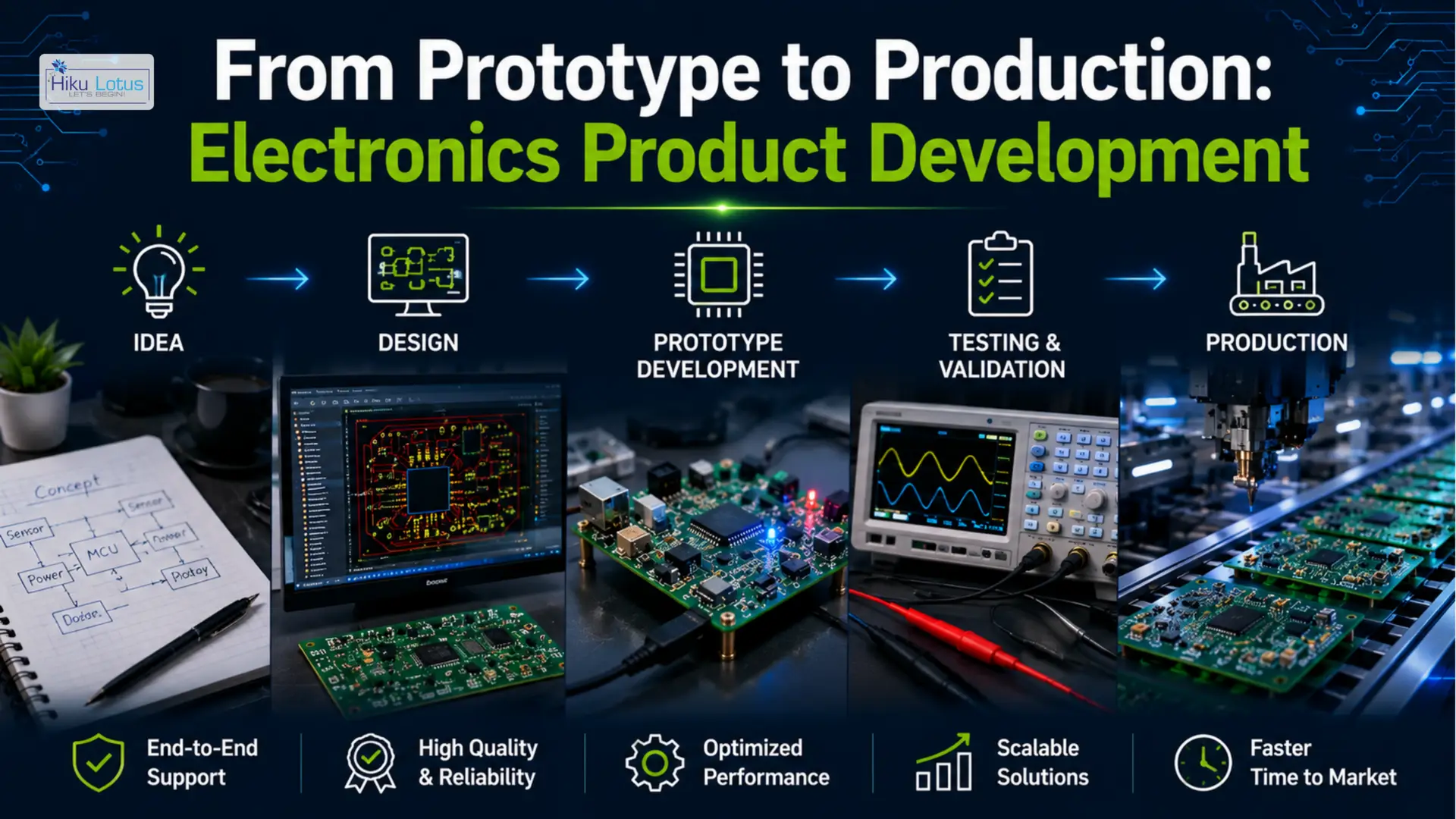
Idea → Design → Prototype → Test → Improve → Validate → Production
By investing time in proper prototyping and validation, businesses can make better engineering decisions, reduce development risks, and build more reliable electronic products.
At Hiku Lotus, we combine electronics design, PCB development, embedded systems, firmware, prototyping, testing, and production support to help businesses turn electronics concepts into practical and production-ready products.
Talk to Hiku Lotus About Your Electronics Prototyping Project
Have an electronics concept, PCB design, or prototype that needs to be tested and developed further? Hiku Lotus provides complete electronics prototyping and product development support, from circuit and PCB design to embedded firmware, prototype assembly, hardware-firmware integration, testing, optimization, and production support. Get in touch with our team to discuss your requirements and validate your next electronics product.
Frequently Asked Questions
1. Why is prototyping important in electronics product development?
Prototyping allows engineers to physically validate the design, identify problems, test performance, and make improvements before moving into production.
2. Can Hiku Lotus develop a prototype PCB?
Yes. Hiku Lotus can support PCB development and prototype testing as part of the electronics product development process.
3. Can hardware and firmware be tested together?
Yes. Hardware-firmware integration can be performed during prototype development to verify complete system functionality.
4. What problems can an electronics prototype identify?
A prototype can reveal power, thermal, signal integrity, communication, sensor, firmware, mechanical, EMI, manufacturing, and usability issues.
5. Is a prototype the same as a production PCB?
Not necessarily. A prototype is primarily used for validation and development. After testing, the design may require optimization before production.
6. How many prototypes are required?
The number depends on product complexity, testing requirements, design maturity, and the number of iterations required. Some projects may need only one prototype revision, while more complex products may require several iterations.
7. Can an existing prototype be improved?
Yes. An existing prototype can be reviewed and optimized for performance, reliability, cost, PCB layout, component availability, manufacturability, and production requirements.
8. Does prototyping increase product development cost?
Prototyping adds an upfront development cost, but it can help identify and correct problems before larger production quantities are manufactured. The number and scope of prototypes should therefore be planned according to the project’s technical and production risks.